
New in ShipJunction: Dual Dimensions for Cartonization and Dimensional Weight Control
Carriers have changed how dimensional weight is calculated, and it is impacting your margins. Individual box dimensions are now rounded up and are subject to an additional correction fee if a correction is required.
To protect our customers from unexpected shipping costs and surcharges, operations teams can now define both interior and exterior carton measurements in ShipJunction’s cartonization module. Interior box dimensions are used to determine what fits inside, while exterior box dimensions are used for carrier rating and shipping. This helps teams pack quickly and accurately, rate shipments more precisely, and avoid costly surcharges from inaccurate DIM weights.
At first, this doesn’t seem like an important distinction. However, with recent changes in how box dimensions are treated by the carriers, it has become a crucial factor impacting carrier costs that can be avoided.
Jump to Dual Dimension Cartonization Software
What Changed with Carrier Dimension Rounding?
Historically, shipping carriers rounded to the nearest whole inch to determine the audited dimensions of packages for billing.
For example, a dimension of 12.49 inches was rounded down to 12 inches for billing purposes. A dimension of 12.50 inches was rounded up to 13 inches.
Additionally, if incorrect dimensions were used initially to rate and print the shipping label, most carriers were simply billing the difference between the original rated amount vs the actual rate using the carrier’s audited measurements.
This has changed in two very material ways:
- Carriers are now using ceiling rounding, meaning any fraction of an inch rounds up to the nearest whole inch. As such,12.01 inches is now rounded up to 13 inches.
- Additional correction fees are being billed if the carrier has to correct the dimensions and re-rate the shipment. Not all carriers are doing this yet, but it would be safe to speculate that this will be more widely adopted.
The difference between interior dimensions and exterior dimensions has always existed but until recently, it wasn’t punitive. Fractions of an inch that previously were rounded down can now potentially result in additional handling changes and large package surcharges.
For certain packages profiles, 1 extra inch can trigger additional charges. For example:
- Additional Handling Dimension charge in the range of $30-40
- Longest side > 48” or
- Second longest side > 30” or
- Length+girth > 105” or
- Volume > 10,368 in (cube)
- Large Package/Oversized charge in the range of $220-$330
- Longest side > 96” or
- Length+girth > 130” or
- Volume > 17,280 in (cube)
Standard Corrugate Boxes Use Interior Dimensions
The leading suppliers for standard corrugated boxes manufacture and identify their boxes using interior dimensions. A 12 x 12 x 12” corrugated box has interior dimensions of 12 x 12 x 12″. You have an internal volume of 1 cubic foot in which to pack your products.
Given the thickness of the corrugated cardboard itself, the external dimensions for this box are going to be fractionally larger than 12 inches.
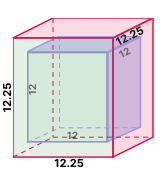
However, with the new ceiling rounding for dimensions, this would now be rated as a 13 x 13 x 13” box. In this example, you are effectively paying to ship the equivalent of 1.27 cubic feet of volume while only having 1 cubic foot available to pack product into.
Because corrugated boxes are typically manufactured and sold based on interior dimensions, carriers effectively rate these boxes as if an extra inch has been added to every side. You can easily see how this would shift shipments into the next more expensive tiers on the carrier rate tables. This is particularly pronounced at the thresholds that incur additional charges such as additional large package/oversized handling charges.
Dual Dimension Cartonization Software Update
Dual-Dimension Cartonization enables you to manage both interior and exterior box dimensions:
Interior Dimensions: This is used by our packing algorithms to determine what can fit inside. The internal length, width, and height establishes the packable interior space of the box. With interior dimensions configured, ShipJunction can automate packing decisions and determine which items, or item combinations, fit into each carton based on item size, shape, and available box space.
Exterior Dimensions: The exterior length, width, and height fields establish the carton dimensions that are used for rating.
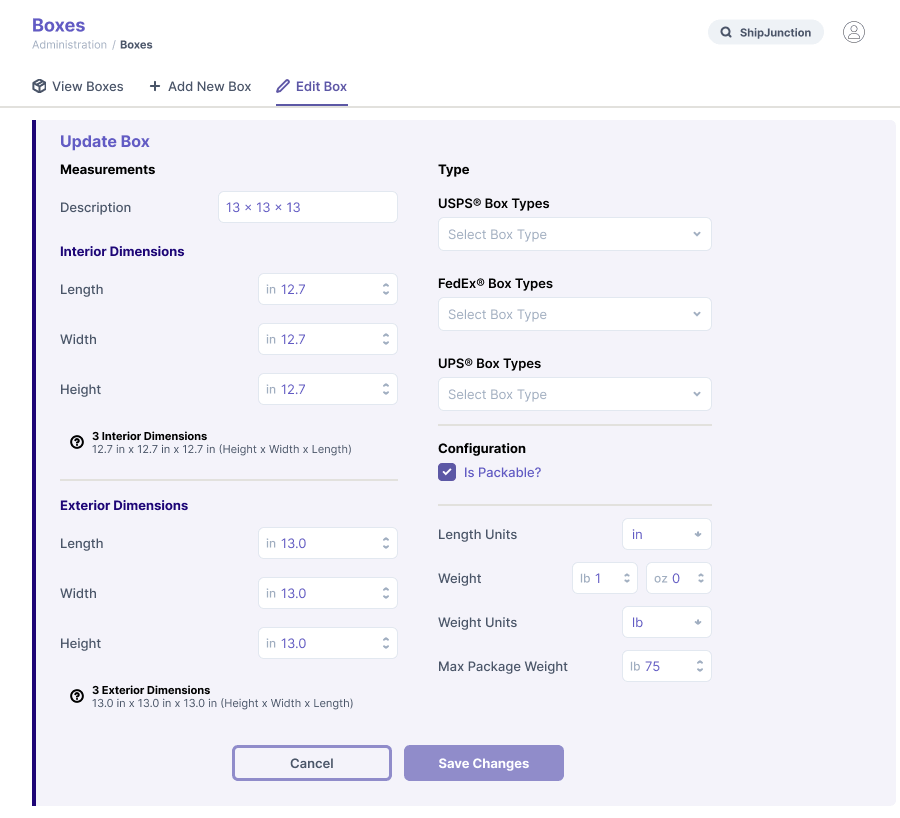
With ShipJunction cartonization, you ensure that you are using the smallest box needed to ship an order which translates to the lowest cost option. Why pay more to ship air? Have this decision automated so that bigger boxes are not unnecessarily being used just because it’s convenient.
Key Takeaways
Incorrect carton dimensions may not seem like a major issue on a single shipment. But across hundreds or thousands of packages, even small measurement gaps can lead to repeated billing corrections, audit fees, and carrier surcharges
There are two key action items you can apply forward:
- Since you are going to be charged for rounded up dimensions, acquire boxes that allow you to utilize the additional volume you are paying for. For illustrative purposes, acquire a box with external dimensions of 13 x 13 x 13 and internal dimensions that are fractionally smaller than these measurements given the thickness of the corrugate.
- Double check your exterior package dimensions and make sure that your shipping rules are correctly rating using accurate external dimensions so that you are not surprised by carrier billing corrections and surcharges.
Schedule a ShipJunction demo to see how Dual-Dimension Cartonization helps your team pack from the inside of the box while rating shipments with exterior measurements.